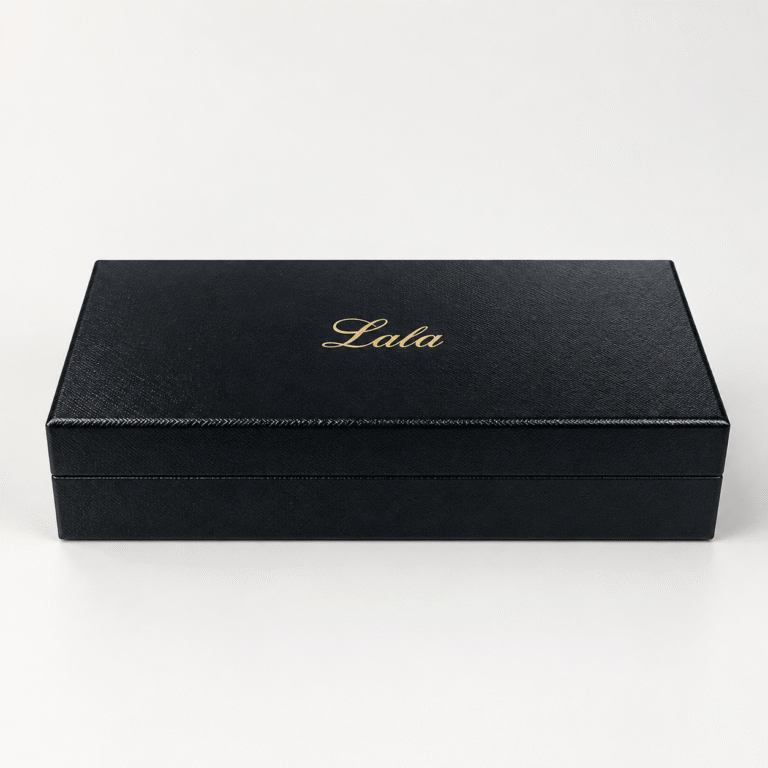
One question we frequently hear from customers is: Why does a custom packaging sample cost several times more than the unit price of mass production? For example, if a finished wooden box costs $40 per unit in bulk production, why might making just one sample cost $300 or even more?
A Custom Sample Is a Development Project, Not Just a Single Box
The biggest misunderstanding about sample costs is that buyers often compare the price of one sample directly with the unit price of mass production. In reality, these two prices represent different manufacturing processes.
Mass production benefits from standardized procedures, bulk material purchasing, efficient machine operation, and repetitive assembly. Once the production process is established, the initial setup costs can be distributed across hundreds or thousands of units.
A custom sample, however, requires many of the same preparation steps, even if the factory only produces one or two pieces. The factory must organize the materials, prepare the equipment, develop the structure, and arrange skilled workers to complete the prototype.
In other words, mass production focuses on manufacturing efficiency, while sampling focuses on product development and verification.
Engineering Development Requires Specialized Expertise
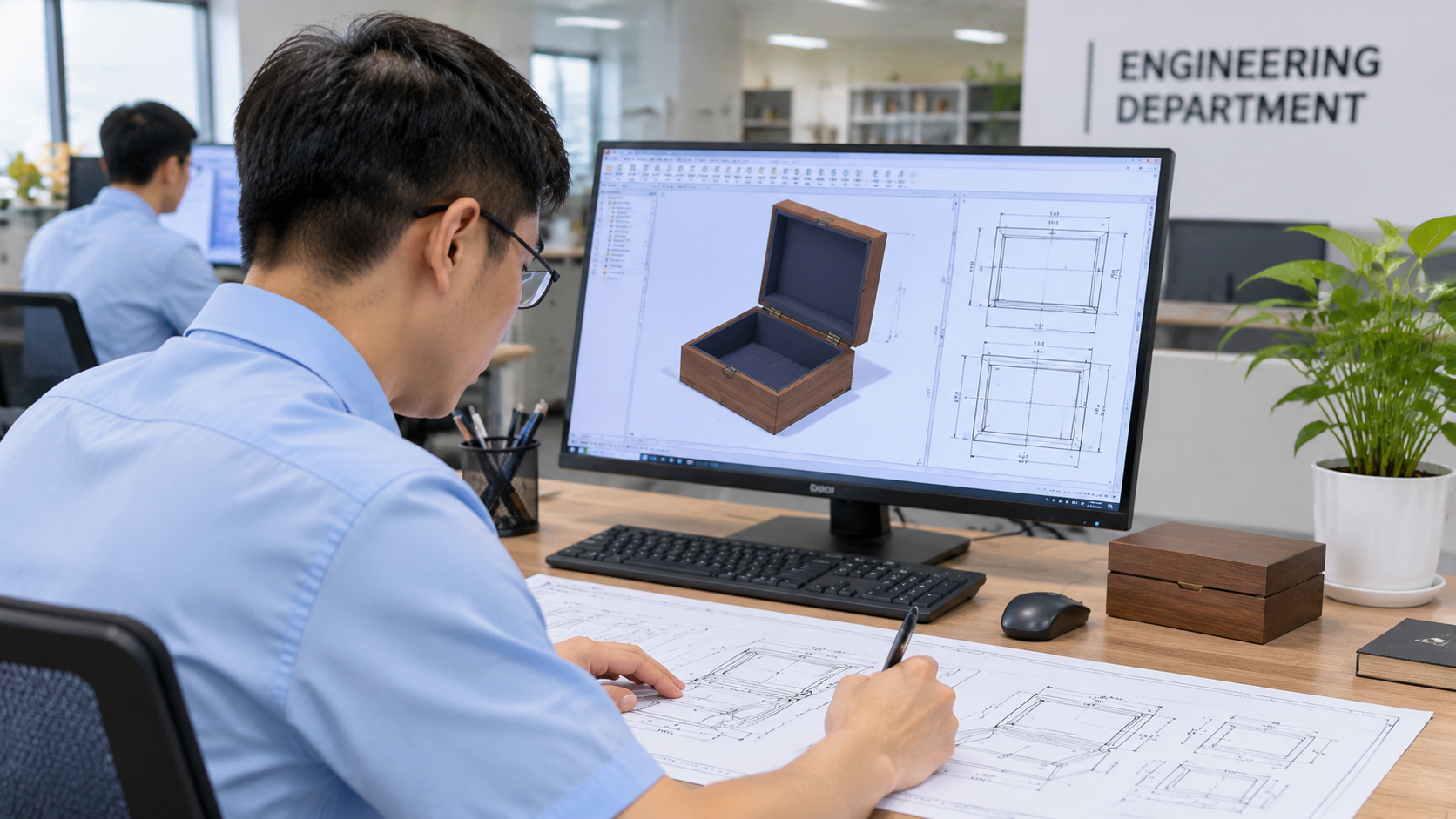
Before producing a physical sample, the engineering team needs to understand the customer’s requirements and translate them into a workable manufacturing solution.
Depending on the packaging design, this may involve:
- Preparing engineering drawings and structural specifications.
- Confirming dimensions, tolerances, and material thickness.
- Developing internal inserts and product-fitting structures.
- Determining assembly methods and opening mechanisms.
- Planning surface treatments, printing, and decorative finishes.
For complicated wooden boxes, luxury gift boxes, or customized presentation cases, this work requires considerable technical experience.
At Dianya Packaging, we have a dedicated engineering team responsible for translating customer concepts into manufacturable products. The salaries of experienced sample technicians and engineering specialists are several times higher than those of ordinary production workers because their jobs require specialized skills and experience.
These professional development costs are part of the sample-making process, even though they may not be visible in the finished product.
Materials and Machine Setup Can Be Expensive for Small Quantities
Material costs are another important reason why a sample can be more expensive than a mass-produced unit.
During mass production, factories can purchase materials in bulk and benefit from better supplier pricing. However, making one customized sample may require purchasing a small quantity of special materials that cannot be bought economically in single-piece quantities.
For example, a luxury wooden box may require:
- MDF or solid wood with a specified thickness.
- Custom veneer, decorative paper, or leatherette.
- Special colors of paint or lacquer.
- Velvet, microfiber, or other customized interior materials.
- Metal hinges, locks, handles, or decorative accessories.
Even when only one sample is required, the factory may need to purchase a minimum quantity of certain materials.
Machine setup also contributes to the cost. Cutting, polishing, printing, spraying, and hot stamping equipment may require individual adjustments before the sample can be produced. These preparation costs are difficult to distribute when manufacturing only one or two pieces.

Skilled Manual Labor Is a Major Part of Sample Costs
For premium packaging, manufacturing is not entirely automated. Many processes still depend on experienced technicians and skilled workers, especially when producing complex structures or achieving high-quality surface finishes.
Take a customized wooden gift box as an example. Its sample-making process may involve several stages:
- Engineering drawings: Approximately 3 working days to prepare and confirm the technical drawings, depending on complexity.
- Woodworking: Approximately 3 working days for cutting, shaping, and assembling the wooden structure.
- Sanding: Approximately 3 working days for surface preparation and achieving smooth edges and corners.
- Painting: Approximately 3 working days for spraying, drying, polishing, and achieving the required finish.
- Interior craftsmanship: Approximately 3 working days for cutting, fitting, and assembling the customized lining by hand.
These are illustrative estimates for a complex sample project, not a fixed schedule for every box. Some processes can overlap, while others depend on drying time, design complexity, and material availability.
Nevertheless, this example demonstrates how much professional labor can be involved in producing a single prototype.
In some projects, the total labor cost alone may exceed the sample fee charged to the customer. Therefore, the sample fee is not necessarily a reflection of the actual cost of developing the product. It often represents only partial recovery of the resources invested by the factory.

Case Study Analysis
A customer wants to develop a premium wooden Jewelry box. The expected mass production quantity is 500 pieces, with a quoted unit price of $40. However, the first customized sample costs $300.
Why is the sample more expensive?
| Cost Factor | One Custom Sample | Mass Production |
|---|---|---|
| Engineering | Individual design and development | Existing drawings are reused |
| Materials | Small-quantity purchasing | Bulk purchasing at better prices |
| Machine Setup | Individual adjustment and testing | Setup costs distributed across units |
| Labor | Specialized manual work | Repeated and standardized operations |
| Production Efficiency | Low | High |
The $300 sample is not simply an overpriced version of the $40 production box. It represents a combination of development, preparation, and prototype manufacturing costs.
Once the sample is approved, the factory can move into a more efficient production process. The same engineering drawings, confirmed materials, and established manufacturing procedures can be used for the entire order.
Is Paying for a Sample Worth It?
Some buyers consider skipping the sampling stage to reduce initial costs. However, this decision can create much greater risks when the product enters mass production.
A physical sample allows customers to check important details before committing to a large order, including:
- Dimensions and structure: Does the product fit properly? Is the box strong enough?
- Material quality: Are the selected materials consistent with the brand’s expectations?
- Surface finishing: Does the paint, printing, or hot stamping achieve the desired appearance?
- Interior design: Does the insert hold the product securely and present it attractively?
- Functionality: Do the hinges, magnets, locks, and opening mechanisms work correctly?
Imagine ordering 1,000 customized gift boxes without approving a physical sample. After production, you discover that the interior insert is too tight, the lid does not close properly, or the surface color differs from your expectations.
Correcting these problems after mass production may require additional labor, rework, or even remanufacturing the products. The resulting financial loss could be much greater than the initial sample fee.
Sampling is therefore an important quality-control step that helps identify potential problems before they become large-scale production issues.
Conclusion
A higher custom packaging sample fee does not necessarily mean that a supplier is overcharging. It reflects the engineering expertise, material preparation, equipment setup, and skilled labor required to develop a customized product in a small quantity.
At Dianya Packaging, sample fees are not intended to generate extra profit, but to cover part of the development costs involved. More importantly, they represent our commitment to working closely with customers and turning their ideas into products ready for mass production.
If you are planning a customized wooden box, luxury gift box, jewelry box, watch box, or other premium packaging project, feel free to share your reference images and specifications with our team. We will be happy to evaluate your requirements and recommend a suitable sampling solution.